Remastering a Sega classic from the game's own memory
Altered Beast (1988) still runs on an emulated Mega Drive, untouched. A new renderer reads the console's memory every frame, finds every character and what pose it's in, and draws the scene again in hand-painted high resolution.
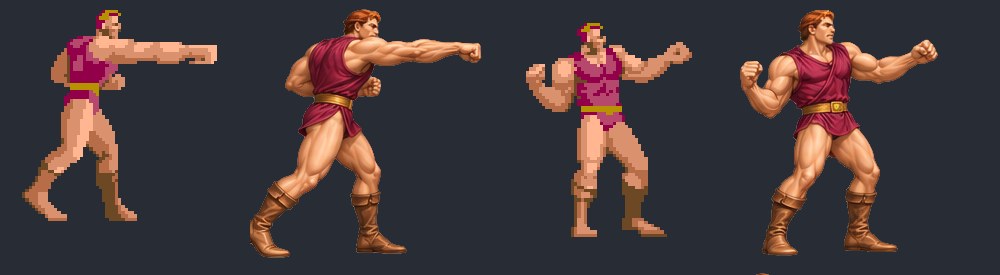
Keep the game, replace the picture
Most remasters rebuild the game and try to make it feel the same. This one doesn't rebuild anything. The original cartridge program runs in an emulator exactly as it did in 1988, so the controls, timing, hit boxes and enemy patterns are the original's, because they are the original. Wonder Boy: The Dragon's Trap did the same in 2017 and it's why that remake feels right.
What changes is the drawing. Instead of showing the console's own picture, a new renderer built in Bevy, a Rust game engine, draws every frame itself, in high resolution, from what the game is doing at that moment.
Reading the game's mind
The game keeps every object on screen in 79 fixed slots in memory: the player in the first, then enemies, shots and pickups. Each slot holds the object's type, its position, and the address of the exact sprite frame it is showing. That address is the key. It names one specific picture in the cartridge, so the renderer can swap it for an HD drawing of the same frame and place it where the game put the original.
- Objects
- Read from the 79 slots every frame: type, position, and the frame being shown. A frame with a redrawn version is drawn in HD; anything not redrawn yet falls back to the original sprite.
- Backgrounds
- The console's two scrolling layers are stitched into full-stage panoramas while the stage plays, then placed by the game's own scroll values, row by row, so the parallax stays exact.
- Screen text
- The score and lives come from the console's fixed window layer, so the interface is the game's own.
- Check
- Drawing the original art, our renderer matches the console's own frame to within 1.5% of pixels. One key switches between the original look and the remaster while you play.
Redrawing the frames
Playing through the first stage with a frame dumper running finds every distinct picture the game shows: 156 of them. Each one has to be redrawn so that it still lines up with the game's own hit boxes and animation timing.
The first attempt redrew frame by frame with an open diffusion model guided by each sprite's outline. Single frames looked good. Animated, they flickered, because every frame came out in a slightly different style. What worked was packing all of one character's frames onto a single sheet and having an image model redraw the sheet in one go, so the whole set shares one style. The sheet is then split back into frames and each one is fitted to the original by its silhouette, scale and position, with a small in-browser studio to nudge the few that drift.


| 79 | object slots read from the console's memory every frame |
|---|---|
| 156 | distinct sprite frames the first stage shows |
| 66 | redrawn so far: the hero in his first two forms and the stage's undead |
| 1.5% | pixel difference between our renderer and the console, drawing the original art |
Where it came from
This is the smaller, finished version of an idea we first tried on a much bigger game: remastering World of Warcraft's textures. The method is the same, take the art out, redraw it, put it back without touching the game, done on a game small enough to see through from the title screen to the end of a level. Backgrounds and the hero's beast transformations are next.